Sunday, March 19, 2017

Prompt 10: Recognizing Truth

By Xavier Reinders

As with many fields and focuses Computer Science and Engineering (CSE) is subject to misconceptions and misrepresentations in popular media. Being as broad as it is CSE runs into a large amount of these problems, from over generalization, to sensationalizing, and straight up stereotyping. In this particular post I can not cover every problem out there or even name every piece that contains a problem like this, so for right now I am going to use a single example to point out some flaws that are common with the representation of the CSE field. To do so I am going to analyze the popular TV show "Mr. Robot" and highlight how it gets some things right and others wrong.

First things first, sensationalizing, or the act of presenting something in a way that provokes interest in the public while sacrificing accuracy. Does Mr. Robot do it right or wrong?  Right actually, while it is a little grandiose, it stays within the general logic limits of CSE and the exaggeration only comes in the theatrics and not the method.
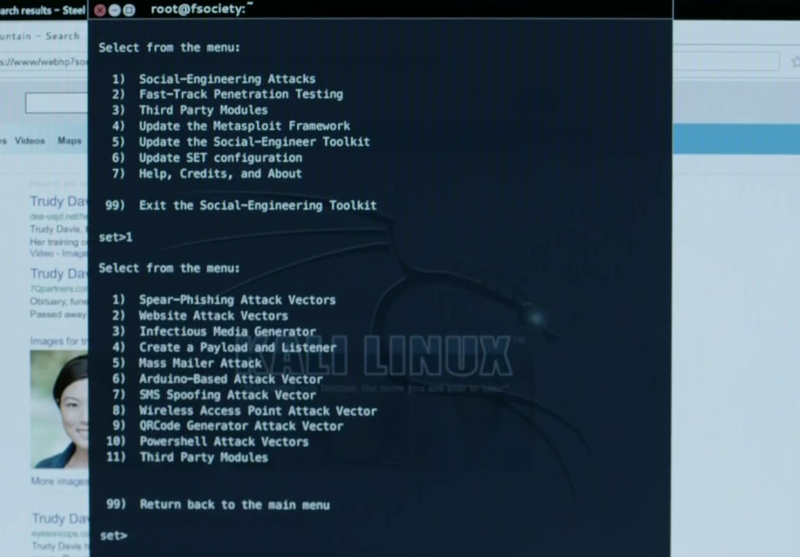
So a determined hacker sits at his computer and pounds on the keys millions of lines a minute to retrieve one single line of information to hand off to the super spy who goes off to save the world right? Wrong, as a human being you are already behind in the CSE world, you are slower and less educated on the system than the system itself. So what does a real hacker do? They write a program, make a computer to outsmart the other computer. Basically a professional hacker, which is a thing, creates a program that does all the computation for them and just tells it which computing to do. Mr. Robot shows this well as you do not see him sitting down at his computer to race the system but rather he runs programs to beat the system.

Next, lets look at representation, Mr. Robot in the show is a cooperation hating, anti-social, save the world vigilante working for a hacker group trying to bring down the cooperations that run the world.  Although I'm sure some in the CSE field are like this, just like there are probably some in every profession,  it is not a large or incredibly pronounced group.  Most people in CSE work for some company or another, not an underground hacker cell trying the Fight Club Approach™, and are generally law abiding citizens who work IT, system management or are programmers. However professional hackers are a thing as I said above and Mr. Robot actually works as a legal one in the show, their job is to try and break a companies security so the company can plug any holes.

Like with the hate the world sentiment above there are a fair few in CSE that are anti-social but most are pretty social people and some are even famous, Zuckerberg and Gates are good examples. Also as a general rule CSE majors do not get to be alone while they work, a majority will work in groups or project teams and because of their broad reach will have to interact with all parts of a company or outside customers.  So while we may not be the most social group we also do not spend all our time in a dark hoodie with only our computer screens to light the way and general hatred for the world to fuel us.

An Introduction to AMD's Ryzen

By Steven Wang

If you are into computers at all, you probably have heard about AMD's new Ryzen line of processors that has demonstrated groundbreaking performance. It has been hyped for all while now but what does this all mean?

First off, what even is a processor and why is it so important? The central processing unit or CPU is essential the brains of the computer that uses electric signals to carry out interactions of a program by performing arithmetic, logical, and control operations specified by other parts or the user. In a computer, the CPU is located inside the motherboard under a fan to keep in cool.
Example of a CPU that has been properly installed 
What a CPU looks like (Intel)
For years, Intel has dominated the CPU market and is mainly known for its "core" line of CPUs such as the core i3, i5, and i7. Each has its own unique features such as number of cores and clock speed and are usually higher as you go up the line. In basic terms, the more cores a CPU has the more data it handle and higher the clock speed means it can compute tasks faster. Although AMD generally has more cores in their CPUs, Intel processors are still faster per core. When building or choosing a computer to purchase, often times people are recommended AMD processors only if you're on a budget. With the addition of Ryzen, however, the competition may change.

On March 2nd, three versions of the Ryzen 7 were released to the public: the 1700, 1700X, and the 1800X. Specifications and prices can be found in the image below:


Comparing to Intel's top of the line Core i7-6900k with similar specifications (eight cores and base clock speed of 3.2 gigahertz) priced at $1099, its hard not to go with AMD. Even its based model, which is nearly a third cheaper, it has the same number cores albeit with a lower base clock speed. Tests have also been done and proves AMD Ryzen can sometimes match or even outperform the 6900k in many tasks such as gaming and content creating.

These are extremely high end CPU and are targeted to consumers looking for the best of the best. However, if the rumors are true, AMD is planning on releasing lower end parts for the more average consumer and to compete with Intel's core i3 and i5.

Want to learn more about Ryzen? Watch a full detailed video here!
Links to benchmarks and other shenanigans:
1. UserBenchmark
2. Builds with the CPU
3. Pricing and Availability 


What is DirectX?

By Qingyang Li

Back to the time when computers were using Windows XP system,  at that time, when someone got a new computer, he had to install some basic software by himself, especially when run a computer game at first time, sometimes it would show a error that said you have to install a software named DirectX. This error is not common after windows 7 system, because almost every computers have already automatic installed this software.Anyway, why this software is so important that we can't run game on PC without it?

DirectX, first released in 1995,full name is Microsoft DirectX and is a collection of application programming interfaces(APIs) for handling tasks related to multimedia, especially game programming and video, on Microsoft platforms. Originally, the names of these APIs all began with Direct, such as Direct3D, DirectDraw, DirectMusic, DirectPlay, DirectSound, and so forth. The name DirectX was coined as a shorthand term for all of thses APIs (the X standing in for the particular API names) and soon became the name of the collection. When Microsoft later set out to develop a gaming console, the X was used as the basis of the name Xbox to indicate that the console was based on DirectX technology. The X initial has been carried forward in the naming of APIs designed for the Xbox such as Xlnput and the Cross-platform Audio Creation Tool(XACT), while the DirectX pattern has been continued for Windows APIs such as Direct2D and DirectWrite.

Direct3D (the 3D graphics API within DirectX) is widely used in the development of Video games for Microsoft Windows and the Xbox line of consoles. Direct3D is also used by other software applications for visualization and graphics tasks such as CAD/CAM engineering. As Direct3D is the most widely publicized component of DirectX, it is common to see the names " DirectX" and "Direct3D" used interchangeably.

Summary, DirectX allows software to write instructions directly to audio and video hardware, improving multimedia performance.Game that include DirectX have the capability of utilizing multimedia and graphics accelerator features more efficiently.

The DirectX software development kit(SDK) is available as a free download.While the runtimes are proprietary , closed-source software, source code is provided for most of the SDK samples. Starting with the release of Windows 8 Developer Preview, DirectX SDK has been integrated into Windows SDK. So this is why after Windows 7 ,we are no longer need to install DirectX by ourselves.


How Video Game Companies Have Changed Their Marketing

By Tanner Fred

In the early games of videogames, when they were nowhere near as popular as they are today, most companies made their as you would expect, through game sales. But as the companies have developed, so has their marketing strategies. Now most of the money that companies make are through microtransactions and DLC.

Now you're probably wondering what those words mean. In games there are instances were you can make purchases that will help to improve the gameplay. For example, in Call of Duty you can be crates that will unlock different weapon skins or character customization options that won't necessarily make you better at the game, but could make the game more fun. As these visual parts of a character have become a more important part of the gaming community, companies have realized that they could use this as a way to make additional profit. These instances would be considered microtransactions.


Now DLC is a bit different. DLC is an acronym that stands for downloadable content. What this means is that a company will release additional content to the game that either extends the games story or adds additional multiplayer options. For example, again using Call of Duty, they will release the base (called vanilla) version of the game and then will sell four additional multiplayer maps as DLC for $20. They will normally do this four times a year, or give you the option to buy the season pass where you will get all of the DLC for $50. Companies have made an absurd amount of money off of this strategy and at this rate will continue to do so.

Image result for black ops 3 season pass

Prompt 4: Considering Delivery and Style

By Tanner Fred

When reading through the blog of University of Texas student Eric Lee's blog, there are a lot of things that I learned when comparing to a scholarly written article or journal. Even if a blog is considered to be delivered in a serious matter, it is very difficult to deliver a blog in a professional manner that would be used by professionals. When professionals deliver their findings or the information that they have, it is mostly used in an article of some sort, an essay, or a journal.

The reason that the article version, written by professionals in the field, is more reliable and trusted is because these people have experience in the field and have more extensive knowledge of the information in the field. Although the writer of the blog, in this case Mr. Lee, may be quite knowledgeable on the subject, it is not comparable to somebody with years of professional experience. The audience of the two posts are also quite different though due to the method of delivery. The audience of the blog post by the student would be directed more at other college students, as well as possibly high school students that are considering entering the field. Meanwhile, an article written by a professional would most likely be to publish their work and therefore would be written for other professionals in their field. When reading through a blog we learn how the field is viewed from the perspective of somebody who has an outside view of the field, while with the article we have a much more professionally written perspective view from somebody in the field.

Click here to see Eric Lee's blog.
Click here to see the professionally written article.

Sunday, March 5, 2017

Brain-Computer Interface and Mind Controlled Prosthetics

By Xavier Reinders

Jaimie Henderson and Krishna Shenoy of the Stanford research team
The keyboard may be a thing of the past according to a Stanford research effort. Well not really but your brain could be the keyboard of the future. The investigation, detailed here, demonstrated that they could create a brain to computer interface allowing the user to type with their thoughts.

So who cares? Firstly, you do because that is awesome and it is the future people have been talking about in sci-fi novels, movies and comics since the introduction of computers. Secondly, the entire investigation was based on helping those who are paralyzed to better interact with technology. Due to their paralysis it was impossible for these people to interact with technology and very difficult for them to interact with people. With this advancement it becomes easier for them to interact with the outside world through computers. The investigation specifically looked at typing with your mind a much more complex task than the mind controlled prosthetics discussed later. Instead of giving a basic command like "move" or "open" or "close" the researchers were able to give a command like "type s in this field." That is comparable to attempting to bend just one knuckle in a finger. They had to be able to pick out on specific brain pulse out of the millions that are occurring and relay just that one to the computer.

On a less medicinal note this is an amazing break through for computers as a whole. Creating an interface where our brain can instruct a machine is the pathway to advanced cybernetics, awesome video experiences and incredible ease of machinery.  Instead of sending a signal to your fingers and arms to move and hit keys your brain could send a signal to a computer that you want that letter put where ever and skip all the extras. We could develop exo-suits allowing paralyzed people to walk again or create robots controlled by our minds to do work for us. This could even be used to create entirely new body parts for people that do not have them and have them function as they would if they were flesh and muscle instead of fiber and metal.

In fact such a step has already been taken into practice with the existence of mind controlled prosthetics. Before these brain-computer links were developed the revolution in prosthetics was flex sensing, moving a prosthetic based on the measurement of muscles that were still there that would have caused this movement. i.e. if you lost the lower half of your arm, sensors would detect muscle movement in your upper arm and translate it to the prosthetic as if it were actually connected to those muscles normally. Now as computers and our understanding of the human brain improve prosthetics can be created that link to your nerves and brain pathways rather than your muscles. So like I said above a user might think move and the prosthetic would respond, this is an important step for people who lost the whole limb and don't have the remaining muscles to operate a muscle sense prosthetic. In fact these devices are at a point where thoughts can be used to preform the precise movements needed to operate a compute mouse and keyboard.

In the less developed field of feedback researchers and engineers alike are working to transfer information from sensors back into the brain in a way that the brain can interpret as a touch. These combined with the mind controlled prosthetics could lead to full robotic recovery of lost limbs, hands that not only grasp and hold but feel.

What Language Started It All?

John Backus
Behind any command of a programming language, there is code for it underneath. I was
working on a project for my programming class one night and the question suddenly hit me. Who created the first programming language and what was it like compared to modern day code?

FORTRAN was the world's first high level programming language and was developed at the International Business Machine Corporation (IBM) by a team led by John Backus, an American computer scientist. The language was released in 1957 and surprisingly, is still used today for large scale numerical calculations in science and engineering.

The initial release of FORTRAN contained 32 statements, examples are:
- if
- go to
- do
- write
- print
- continue
The six example statements listed above are still used in modern day languages such as Python, Java, and C++ and just shows how advanced FORTRAN was for its time.

Before the development of disk files, text editors and terminals, programs were often entered on punch card using a keypunch keyboard. A punch card with code would look something like this:


One punch card
Looking at the card closely, we can see there are nine rows and eighty columns of numbers. A keypunch keyboard would punch holes in specific places based on the code needed. Compared to a terminal or text editor, the card looks extremely confusing so in order to enhance readability, the columns were divided into four sections:
- 1 to 5 were used to determine command statements such as the ones listed above
- 6 was a continuation field. If a character other than a blank or zero was punched in, this caused the card to be taken as a part of another card. (Multiple cards can be used for one program)
- 7 to 72 were used for statements or the body of your code in today's era
- 73 to 80 were ignored since, at the time, the IBM could only read 72 columns. Since these columns were ignored, programmers could write on them in order to organize the cards if many were used.
When the punch cards were finally finished, they would be fed into a card reader for the computer to compile and run.

 Looking back, it seems like the only main difference between FORTRAN and modern day languages were the speed at which code could be read and functionality. Compared to a text editor, which can compile code in an near instant, the punch card method could take hours to create if huge calculations were need to be done. The cards would then have to be fed individually into the reader which could also take some time. FORTRAN was also mainly used for calculations, however, programming today takes on many other fields such as video game design and web development. Obviously, many changes were implement to commands as well as new ones added, but it shows how far computer science has come while still incorporating its original DNA.


Fun facts about computers

By Qingyang Li

Nowadays, computers have become the most important tools in our daily life. They are completely change our lives in so many ways. Although computers have been developed in decades, there are still some fun facts you may not know,and here I am going to introduce some of them to you.

1. The first electronic computer ENIAC weighted more than 27 tons and took up 1800 square feet.

2. Only about 10% of the world 's currency is physical money ,the rest only exists on computers.

3. Typewriter is the longest word that you can write using the letters only on one row of the keyboard of your computer.

4. Doug Engelbart invented the first computer mouse in around 1964 which was made of wood.

5. There are more than 5000 new computer viruses are released every month.

6. Around 50% of all Wikipedia vandalism is caught by a single computer program with more than 90% accuracy.

7. If there was a computer as powerful as the human brain, it would be able to do 38 thousand trillion operations per second and hold more than 3580 terabytes of memory.

8. The password for the computer controls of nuclear tipped missiles of the US was 00000000 for eight years.

9. Approximately 70% of virus writers are said to work under contract for organized crime syndicates.

10. HP,Microsoft and Apple have one very interesting thing in common-they were all started in a garage.

11. An average person normally blinks 20 times a minute ,but when using a computer he/she blinks only 7 times a minute.

12. The house where Bill Gates lives,was designed using a Macintosh computer.

13. The first ever hard disk drive was made in 1979, and could hold only 5MB of data.

14. The first 1GB hard disk drive was announced in 1980 which weighted about 550 pounds, and the price was 40,000 dollars.

15. More than 80% of the emails sent daily are spams.

16. A group of 12 engineers designed IBM PC and they were called as " The Dirty Dozen."

17. The original name of windows was interface Manager.

18. The first microprocessor created by Intel was the 4004. It was designed for a calculator ,and in that time nobody imagined where is would lead.

19. IBM 5120 from 1980 was the heaviest desktop computer ever made. It weighed about 105 pounds, not including the 130 pounds external floppy drive.

20. Genesis Device demonstration video in Star Trek 2: the Wrath of Khan was the first entirely computer generated movie sequence in the history of cinema . That studio later become Pixar.


Sunday, February 26, 2017

Prompt 1: Asking Questions and Breaking Assumptions

by Steven Wang

Cover Page of Textbook
When high schoolers begin the transition to college and decide their major, the first step is
usually thinking about preconceptions about the field. What do people do? What do they say? What do people like and don't like? With the advancement of technology, Computer Science and Engineering is quickly becoming a more popular major choice. The textbook "The Practice of Computing Python" by William Punch and Richard Enbody will be use to test if certain preconceptions in the computer science field are true or not.

Preconception #1 - Computer Science is All About Programming
Surprisingly, this is not completely true. Although the major is revolved around learning and executing code, I believe the main skill that is taught is simply how to approach and solve a problem. This idea can be backed up in the textbook, where the preface states that "Our goal is that after the course, students when presented with a problem will think, 'Hey, I can write a program to do that!" (Punch, Enbody XXIII). This is also the reason why in many colleges a intro computer science course is required for all engineers, as knowing how to problem solve is an essential skill. 

Preconception #2 - Computer Science is Slow and Difficult For Beginners
Yes, at least from my perspective. I say this as you would be surprised how easy and natural computer science is for some people, being able to just code without even hesitating. For many students, their first experience in the field is often a mixture of frustration and confusion. The textbook wastes no time diving right into creating a program that calculates the area of a circle. Its a simple task on paper, but coding it is different.
Area of a Circle, Written in Python
Immediately, you see statements such as "import" and "print" that haven't been taught before and sometimes are you told "Worry about those later, just memorize it now". Although it does go into detail, the explanation of just eleven lines of code is two pages long, which can easily be off putting to someone who wants to learn quickly.

Preconception #3 - Computer Science is a Part of Every Day Life
This preconception can be tied with #1. We all know that computers are everywhere, millions of them. "What were once rare, expensive items are as commonplace as... any commodity you can imagine" (Punch, Enbody 3). Computer science surrounds us and there are a multitude of examples but to name a few are social media, smartphones, cars, and the internet. Many computer science textbooks have a preface explaining its importance because many students never consider anything outside of what they code.

Overall as a resource, this textbook is highly recommend for students are you starting from the bottom. It teaches the importance of computer science, its uses, and how to code with arguably the most basic language. Even if you think its dense and slow, this is as easy as its gonna get and the learning process will definitely speed up as you go on. 

Oh The Places You'll Go

By Xavier Reinders

So you are looking into pursuing a Computer Science or Engineering degree as a part of your research into this you might wonder what you can do with such a degree.  While I can't give you every possibility I can give you a few big ones and what they might entail.

Software Developer
Software development is a wide and diverse profession and possibly the biggest residence of CSE degree holders. These developers make everything computer related that does any actual computing. This means they make the video games, phone apps, work programs (Microsoft Office), vehicle systems and web applications we see every day.  Due to this variance in work developer pay spans a wide range from $50,000 up to $200,000 and beyond depending on importance.

Computer Systems
Computer systems engineering deals with the interaction between machines, each other and their users. These professionals design, analyze and improve this communication as well as helping non-engineers interact with them. These engineers spend a lot of time interacting not only with these systems but also with the software developers mentioned above helping their programs smoothly move across your systems. Median pay for this kind of work falls around the $82,000 mark.

Database Handlers
Database engineers and analysts work in information; understanding, manipulating and distributing massive amounts of information. Engineers design and build the data storage connecting it to a system where it needs to be in order to allow access to the information. Analysts criticize everything the engineers do, they work to improve system efficiency and the overall quality of the system. These professionals rake in an average pay of $80,000.

Analysts 
Do you hate people and think you can do everything better than anyone else, welcome to the position for you. Not really though analysts preform an incredibly important job that helps to serve the rest of the professions on this list. Essentially their business is problems, finding them and reporting them to however can fix them, however a problem could be as simple as 'this doesn't work as well as it could'. Analysts tend to have a a very wide base of knowledge able to at least partially understand every part of a computer system from software to system to database so as to diagnose issues in each and between all parts. Expected pay falls at $83,000 for these professional criticizers.

Testers
Is your favorite tool a wrecking ball, do you often find yourself destroying "indestructible" items or accomplishing "impossible" feats, boy do I have an opportunity for you. As a tester your job is to find problems, use the computer system in every way possible and find out where it doesn't do what it's supposed to. You act as a digital "breaker" helping others achieve their goal of "idiot proofing" their product by using your to become the smartest idiot ever. These hero's can expect a wide range of pay centered around $83,000.

Network Administrators
You survey your kingdom in search of flaw and those in need of your all powerful influence. In actuality network admin's act as the gate keepers of a system allowing access where it should be allowed and denying it where it shouldn't.  This goes for those inside the system as well as those attempting to access it from the outside. You do however land a little lower on the pay spectrum than others at $77,000 despite your divinely mandated rule.

Project Manager
Congratulations you've successfully done your job long enough and well enough that you get to do that and tell other people how to do their jobs. Project managers set deadlines, outline plans and assign responsibilities for a team of other computer scientists and engineers. Since you're so good at your job you can expect a pay around the upper middle of your team whatever that may be. What? Why aren't you making the most if you're the manager? Because someone on your team is the best at their job, a very specific one that few understand, and they are harder to come by then a project manager. Anyone can be a project manager not everyone has what it takes to write an AI on their own.

Well now that you know all of that I hope your time in CSE leads you to the career you're hoping for whatever it may be.

All pay information pulled from here.

Character Introduction - Alan Turing

By Qingyang Li

Alan Mathison Turing(23 June 1912-7 June 1954) was an English computer scientist,mathematician,logician,cryptanalyst and theoretical biologist.He was highly influential in the development of theoretical computer science,providing a formalisation of the concept of algorithm and computation with Turing machine, which can be considered a model of a general purpose computer.And he is widely considered to be the father of theoretical computer science and artificial intelligence.

The most famous story about Turing is during the World War Two, German scientist developed a machine called Enigma and Nazis force used it to communicate with each troops, this machine and code was unbreakable at that time which caused Allied many losses. Turing worked for the Government Code and Cypher School,Britain's codebreaking centre. For a time he led Hut 8,the section responsible for German naval cryptanalysis. He devised a number of techniques for speeding the breaking of German ciphers, including improvements to the pre-war Polish bombe method, an electromechanical machine that could find settings for the Enigma machine.Turing played a pibotal role in cracking intercepted coded messages that enabled the Allies to defeat the Nazis in many crucial engagements, including the Battle of the Atlantic; It has been estimated that this work shortened the war in Europe by more than two years and saved over fourteen million lives.

After the war, he worked at the National Physical Laboratory,and he designed the ACE here, and it was the first designs for a stored program computer. He helped develop the Manchester computers in 1948.
But unfortunately ,Turing was prosecuted in 1952 for homosexual acts, when " gross indecency" was still criminal in the UK. He accepted chemical castration treatment, with DES(a synthetic,non-steroidal estrogen of the stilbestrol group,from about 1940 to 1971 ,DES was given to pregnant women in the mistaken belief it would reduce the risk of pregenancy complications and losses). Turing died in 1954, Police determined his death as suicide,because they found a bit apple which was covered by cyanide poisoning, but it has been noted that the known evidence is also consistent with accidental poisoning.

In 2009,following an Internet campaign,British Prime Minister Gorden Brown made an official public apology on behalf of the British government for "the appalling way he was treated." Queen Elizabeth granted him a posthumous pardon in 2013.The Alan Turing law is now an informal term for a 2017 law in the United Kingdom that retroactively pardons men cautioned or convicted under historical legislation that outlawed homosexual acts.

If you want to know more about Turing's story of Enigma, recommend to watch the movie "The imitation Game"

Nintendo Switch And Its Early Release Flaws

The Nintendo Switch is the most anticipated game release console in 2017 and is the sequel console to the Wii U. It is the newest advancement in console technology as it allows the gamer to not only use the console as a stationary console, but it also allows the gamer to take the controller from its portable station and use it as a handheld device. It is making many great advances in the gaming community and will definitely impact future gaming consoles to come. But just like all things, it has its flaws, and some of them are pretty major.

The first issue with the console is that, right out of the box, the console is very boring. The game console comes with no games included, so the only thing to do is scroll through the menus and create your mii, unless you decided to buy a game with the console. In addition to that, there is no backwards compatibility offered with the system, so gamers cannot play any of their old Wii or Wii U games. The Switch will be the very first Nintendo console since the GameCube to not offer backwards compatibility. In addition to all of this, virtually downloading games will not be available at release date. What that means is gamers cannot buy games digitally from the Nintendo eShop at the release of the console and would cause gamers to buy their games on cartridges. Another problem adding to the game problem is that the internal storage of the console is only 32GB, which is extremely small for gaming consoles.

These game issues as well as issues with the controllers and battery issues add to the many continuing problems resulting for the Nintendo Switch. For more information about the Nintendo Switch click here.

Sunday, February 19, 2017

Intro to Programming: C++

By Xavier Reinders

Contrary to the title C++ is not the language you should be learning if you are looking for an introduction into the world of programing. While it was the first full programming language I learned it is more often used by schools in an upper level course after students have already learned some introductory programing. The language was created in 1983 by Bjarne Stroustrup with an emphasis on efficiency and performance.

C++'s creator on the 'advantages' of his language
The efficiency part of C++ does not come on the coding end of things but rather on the computing end, so while there is often more work for the programmer, there is much less for the computer or system, ideal for large systems or programs. C++ is often referred to as a mid to low level programming language, these levels denote closeness to machine language, the stuff computers use to communicate and operate.  Since it is a mid to low level language it is closer to the ones and zeros used by the machines which means it is sometimes a bit tricky and difficult for humans to understand. However this human inconvenience allows for a much faster and efficient system using only a few more ones and zeros than are necessarily needed to tell a machine something.

C++'s biggest advantage is rooted in its memory manipulation abilities and its use of pointers and references. One of the biggest memory pit falls of other languages is their use of copies, when passing around information between places they make a copy of that data each time it goes somewhere new. As you might imagine this can quickly take up a lot of space, so C++ approaches this problem differently using pointers and references. Although they are often very complex to implement the concepts behind these two things is pretty simples. Pointers are like a trail sign or a highway sign, they tell you where and what something is in a place totally separate from the original thing. References are like nicknames for a person,  like 'Bill' and 'William', they both mean the same thing and refer to the same person its just 2 different ways of saying it.

I hope this has introduced you to some of the differences between C++ and other languages. If you are interested in programming I would recommend a higher level language like python first, which can be found here. However if C++ is really what you want this site can help you get started into the language.